
Professors Strike at NYU!
Our historic strike and how we won!

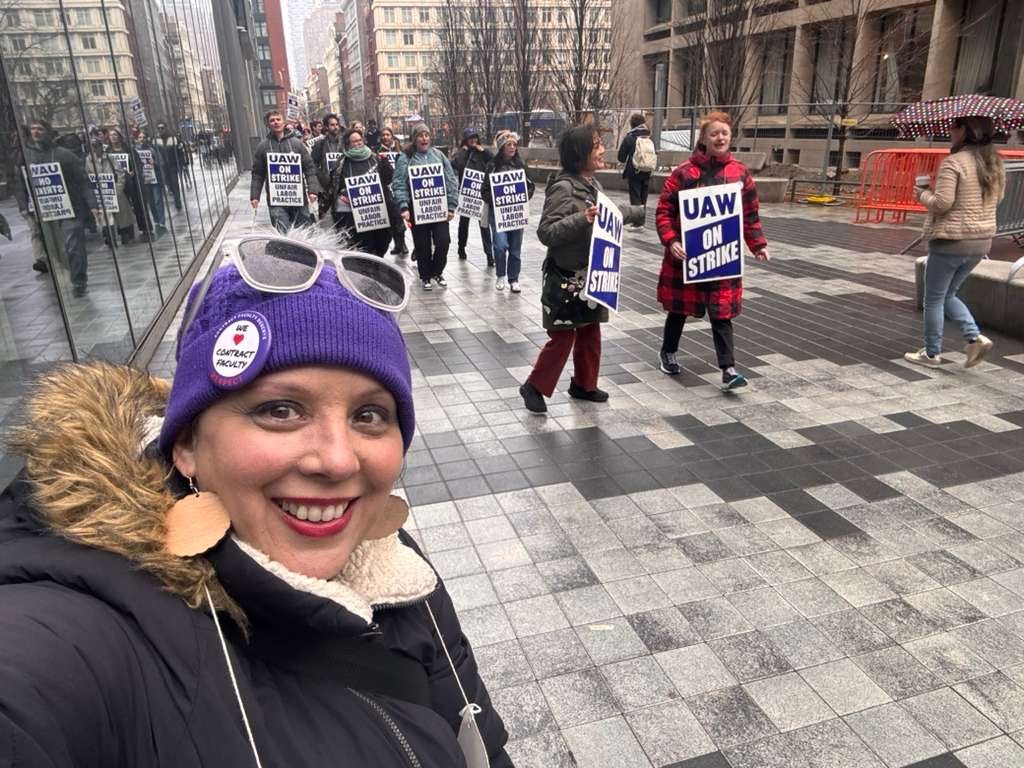
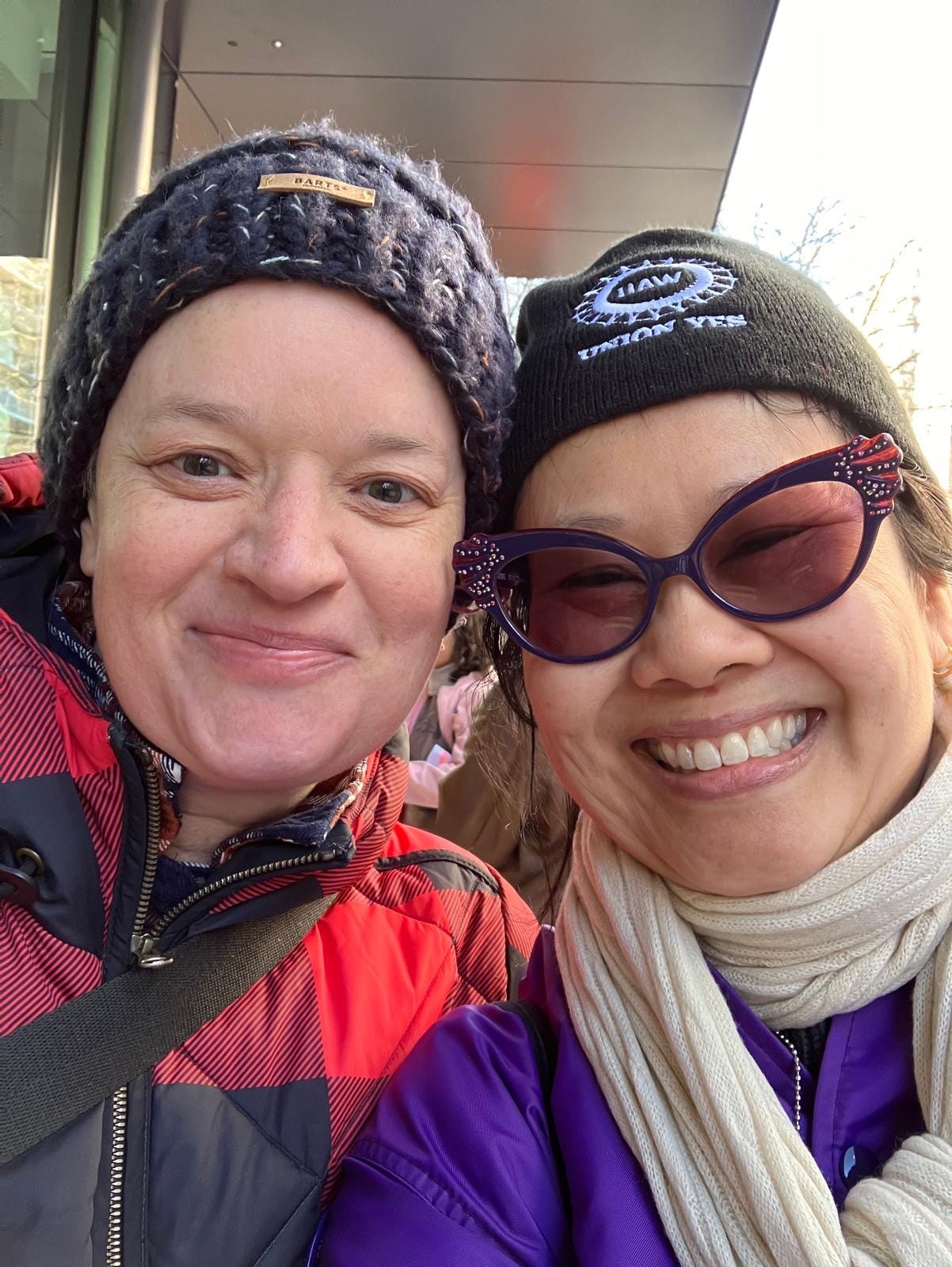
I begin with this selfie by my dear friend and union comrade, Maria Rosa. I love it because she’s in it, looking so happy, and it shows another union bestie, Jean, and me leading the picket line around the newly constructed 1.2 billion dollar Paulson Center at New York University. One of the reasons we chose to picket in front of this building was to demonstrate how much money NYU has and how little it has paid more than half of its full-time faculty.
We picketed for two days, and each day we grew to nearly 400 picketers. When Maria Rosa took this photo it was early morning on the first day, March 23rd. We didn’t quite have enough folks to surround Paulson, which is massive, but we had fun trying. Jean and I led some chants and it was an early moment of empowerment. My voice dropped into a lower register and it felt almost spiritual. Maybe I was channeling the voices of strikers long since passed or my mom when she marched for ERA in the early eighties. I can yell when I need to, and my body realized it was time to get loud.
The steps we took to get strike ready were huge lifts for all of us on the bargaining and organizing committees (hereafter referred to as the BC and the OC). Matt R. likened it to playing a video game that never ends—there was always a new level to conquer. From bargaining sessions to phone banking to getting folks across schools to sign a strike warning letter, to calling a strike authorization vote, to choosing a strike deadline, and finally to organizing the strike itself. At every level we needed a majority of our unit to agree. They stepped up every time.
Most of us who were on the OC and BC were in contact with 20-50 people a day. The BC met for hours every week to draft proposals, strategize, and then sit across the table and make demands without ever losing their tempers. The BC and OC met together weekly, sometimes even twice a week to share information, report back from our turfs across the university, and make important decisions. We then had to share that information with 950 people and make sure everyone was kept up to date.
For me, getting information every where it needed to go, something I started calling “bridging,” was often the most exhausting part of organizing. I also realized I was good at it!
Bargaining emails alone took up hundreds of hours and were mostly drafted by the BC, with editing from whoever was available. BC and OC members were part of several WhatsApp groups that we’re active for most of every day and sometimes into the night. We had a main organizers group, a communications and social media group, and a facilitators group. The BC had their own group.
I was in a Phonebankers Whatsapp and a Liberal Studies WhatsApp because that’s my home school/program. I was also in a Tisch organizers email thread because I’d volunteered to work in that turf. Those WhatsApp threads were fast moving and we often had to make important decisions very quickly. We also laughed and joked a lot because we needed the stress relief and because we all got very close. The threads are much quieter now, and I kind of miss them.
We had hoped that our majority strike authorization vote would get NYU to bargain with us more seriously, but it didn’t. We hoped that NYU would come to the table in meaningful ways in the three weeks leading up to our strike deadline, and they didn’t. We did get a few major wins before the strike like presumptive renewal, but we were very far away on big issues like cost of living wages, compression adjustments, childcare and eldercare paid leaves, international faculty visas, academic freedom, and shared governance.
We were prepared to strike because we’d created committees: picket logistics, accommodations, food and drinks, strike fund and money issues, and a few more I don’t remember. We also arranged for a roster of speakers every day, a hot lunch with snacks and dessert and coffee, places for people to sit and rest, drummers, student supporters, and comrades from other unions on and off campus. Brad Lander and Susan Sarandon visited us and students held Freedom Schools.
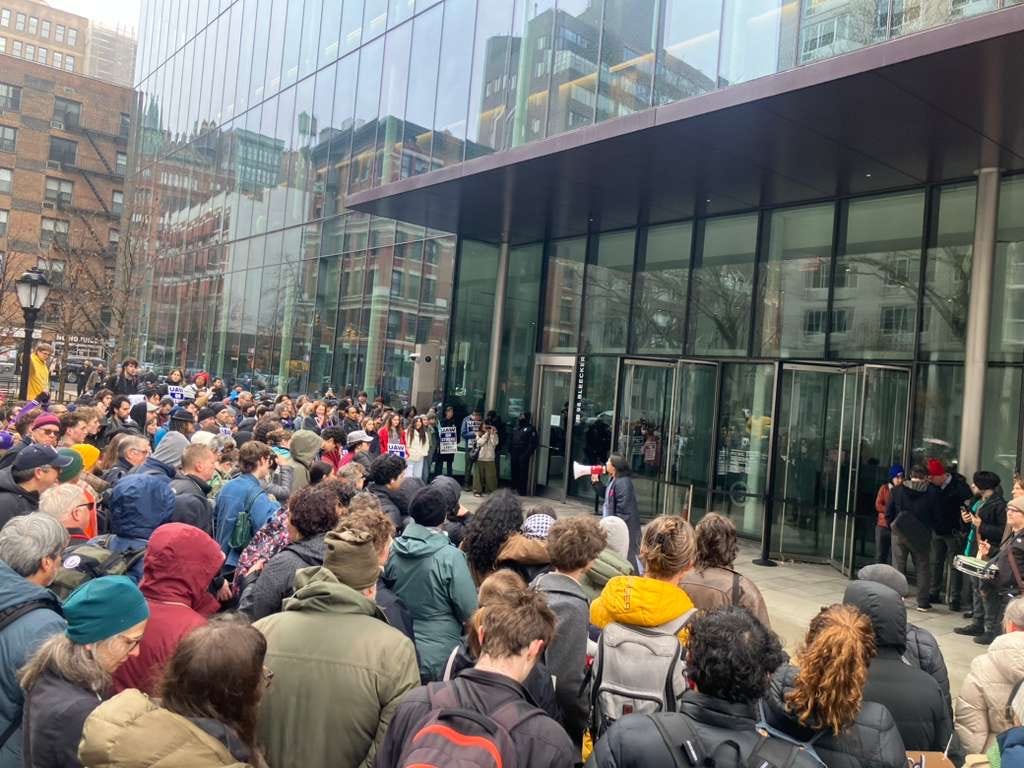
Above is BC member, Jacob Remes, speaking at the end of the first day of the strike. BC members had been bargaining for over 24 hours, and they were exhausted, but we wanted to cheer them on and make sure they were okay. You can also see other BC members, Heidi White and Elisabeth Fay, who is blowing kisses to the audience. I jokingly called Elisabeth and Jacob, Mom and Dad.
Heidi has been one of my closest colleagues for years, and has done more to protect contract faculty than anyone I know. I remember pulling Heidi by the hand through the crowd so that she could be up front with her fellow BC members.
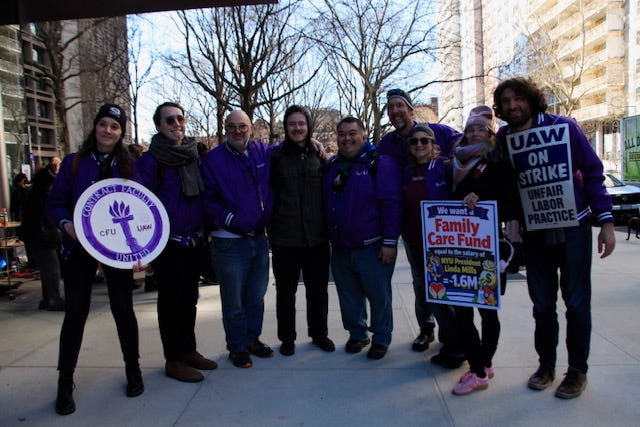
Above is most of our BC (not pictured Heidi White, Fanny Shum, and Chris Chan Roberson) at the picket line.
When I got serious about doing union work a few years ago, I began with “walk throughs” (going to other departments and schools and literally walking through the halls of people’s offices to talk to them) and phone banking to get union members to show up for bargaining, either in person or over zoom.
We had two giant T.V. screens on the back wall of the bargaining room. Imagine those two screens filled with 50-200 faces sitting in their little zoom squares, with the union logo as all of our backgrounds. There were days when we could tell we’d rattled them, and others when we seemed to have no effect at all.
About eight sessions in, I started going to every bargaining session, and for reasons that still aren’t entirely clear to me, I became obsessed with the proceedings. Listening to and seeing our BC of twelve of the smartest people I know (along with our brilliant UAW staffer Dan) present reasonable and fair proposals, make use of data we’d recently gotten access to because we unionized, and gather members to give testimonials about how difficult our lives had become, felt necessary and empowering. We finally got to talk to admin and they had to listen, or at least pretend to.
Because of my attendance at bargaining sessions, I started to be able to answer a lot of questions that came up for members. I also began facilitating meetings, talking to the media, and arranging phone banking sessions so none of us would have to feel like we were calling alone. I got very invested in creating teaching materials so that we could make sure our students knew why we’d formed a union and might strike. These were not activities I’d done in the past, but they were important now and sometimes really fun. I also liked that I was learning new skills.
We don’t talk enough about how much fun organizing and protesting can be, and I loved getting to know new cool people in different parts of the university, who were as political as I am. The union in many ways gave me a second home, which I very badly needed.
Union work became a bit of an addiction. Turning people pro-union, sharing facts, assuaging deep fears and anxieties, working in a part of the university where there were deep anti-union factions—all of it gave me a lot adrenaline, cortisol, dopamine, an/or serotonin, and I didn’t want to stop until we’d won.
I also want to note that there are so many things I didn’t do: I didn’t do walk through anymore because my disabled body couldn’t really handle those, I didn’t create social media or do a lot of our communication because we had an amazing team of super-skilled people and I don’t know Canva, I didn’t do outreach to other union organizations and other faculty groups, and I wasn’t on any strike committees. I point this out because one thing I learned in organizing is that there is so much to do, and picking a lane and an focus really helped me be of use and not completely burn out.
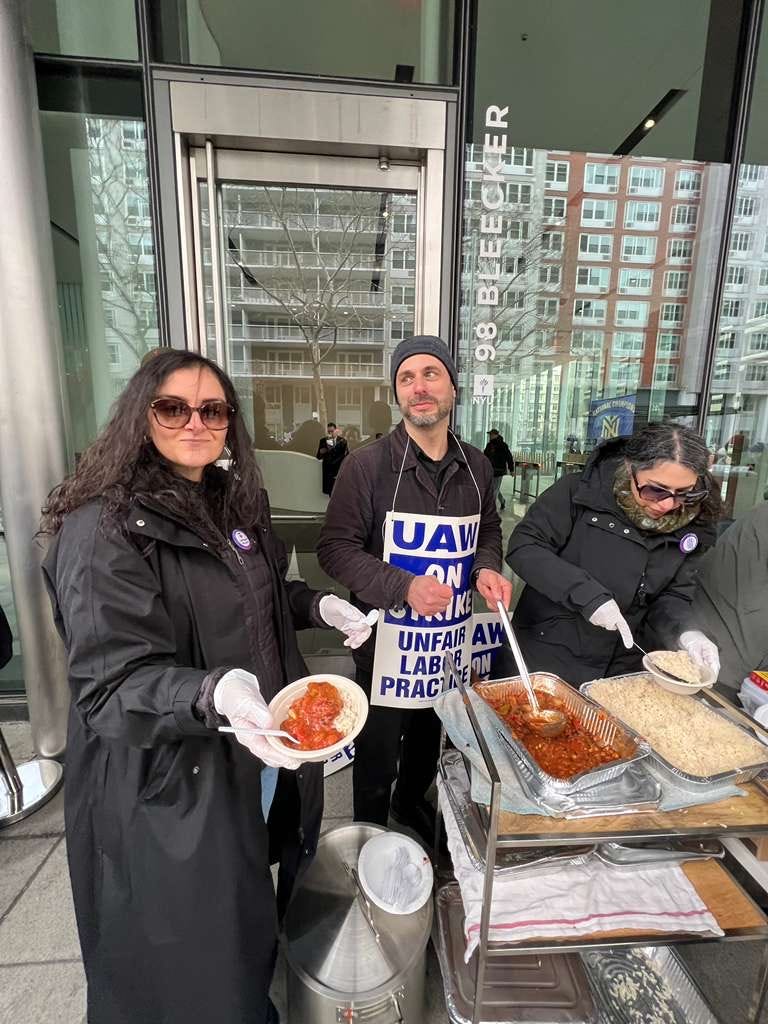
Beloved comrades serving lunch. I hadn’t realized how important this would be for our picketers (which duh!), but it felt very magical. It reminded me of The People’s Kitchen at Occupy Wall Street, though we were a much smaller operation.
There’s been a new chant, or at least new to me, in protests and in social justice circles of late. “We take care of us.” It’s community-minded and encourages mutual aide, solidarity, and collective safety. We’d known for years that the administration wasn’t going to take care of us, a point made even more clear when admin called the NYPD, arresting faculty and student protesters who had occupied spaces around campus to protest the genocide in Palestine.
I learned in those two picketing days that we could take care of ourselves, and that’s also what a union does for its members. I hadn’t anticipated how much we needed to be together on the picket line chanting, singing, dancing, and talking. As faculty who spend the majority of our working lives with students in the classroom, we often don’t have the time or energy to be with our colleagues.
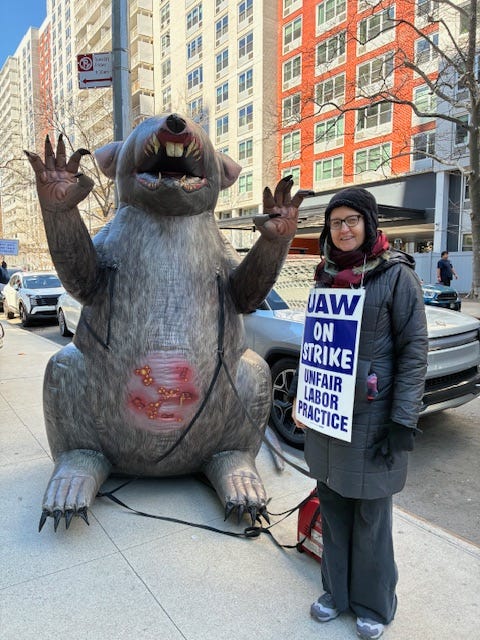
Here’s my new Tisch School of the Arts buddy, Gwendolyn, hanging out with Scabantha the Rat. Scabantha came on day two of the strike, and we all loved her and took photos because she’s a celebrity, and what New Yorker doesn’t secretly love a rat?
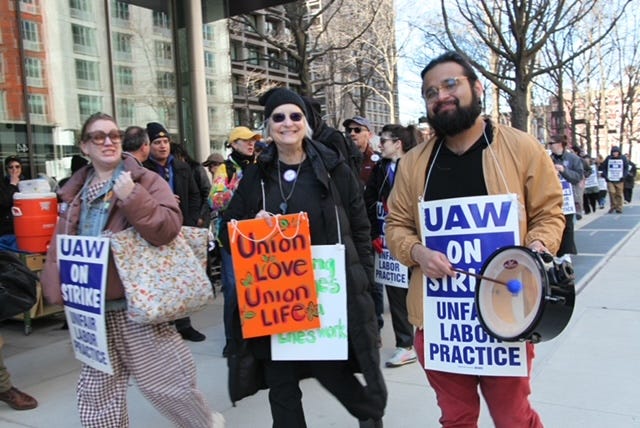
More of our members, drumming and being the best. I don’t know the names of the drummer on the right and the woman on the left, but that’s Maria H. in the middle, who is a third generation union member.
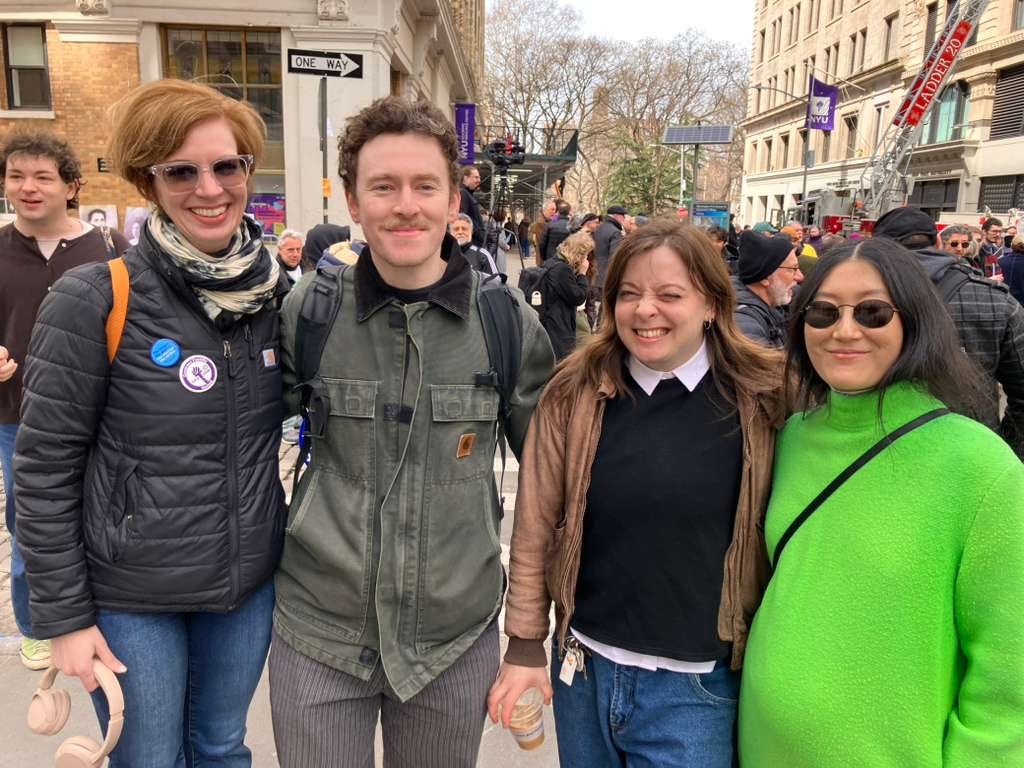
Much to our surprise, after just two days of striking, we won a great contract. Because of the strike, we got a 14k raise across the unit, our salary floors went up significantly, and we addressed compression so that those of us most affected by it, gained even more significant raises. Each year moving forward until the next contract, we get a 3.5.% raise.
We won academic freedom protections, better retirement plans, and some protections against AI. We won presumptive renewal which means after two contracts we no longer have to reapply for our jobs. Some folks are calling it “soft tenure,” and it’s a life changer. Everyone in our unit will now have a $2500 annual research fund and the right to file grievances. There’s a lot more, click here to see.
The last photo is our UAW staff—Caley, Dan, Alex, Annie Lee, and Nathan and Anila who were hiding. These six people are the most talented, level-headed, strategic, tough, kind, funny, and brilliant organizers I’ve ever met. They inspired me and made me feel like I mattered. We wouldn’t have won anything without them.
I worked most closely with Alex and Caley. Alex, who I never saw lose her temper at whatever bonkers thing someone said, and who usually answered with something like, “Let’s think more about this, but I’m sure we can figure it out.” Caley, who made me laugh when folks hung up on me, shared her life with me, and made sure that I’d slept enough. We could never have organized Tisch without Caley.
Contract faculty at NYU started working on forming a union nine years ago. I have always been pro-union but like many people, I didn’t get that I am the union, that we all are, and it wasn’t until the last two years, that I got involved in organizing. I’m so glad I did. There’s so much more to write about what I’ve learned, but I haven’t yet figured out the containers that will hold all of that. These last two posts have been a start.
I’ve seen a couple of headlines lately that the beloved show, The Pitt, set in the chaos of a Pittsburgh Emergency Room led by a traumatized, brilliant doctor, is so earnest sometimes that it borders on what the kids called cringe. I’ll take earnest cringe over cynical passivity and grift any day of the year. Becoming a member of the OC, relieved me of my passivity and fear that nothing would ever change.
Being in a union taught me that people need community and organizing can only happen face-to-face and over the phone when we can actually talk to each other. I learned how hard it is to galvanize people and change their minds, but listening, asking genuine questions, and providing people with the truth are the ways to do it.
As a union we have so much work ahead of us, and I hope to get as many people involved as possible. If you’re reading this and in you’re in my union, don’t thank me (thought that’s very sweet), but join us in the fight ahead.
We’re in a critical moment in this country. Authoritarianism has taken hold in less than two years, and we need every weapon we can find to fight it. Unions have saved us in the past and will save us again. Collective action protects individual workers from the ravages of unfettered capitalism. If a group of 950 risk-adverse professors, whose median age is 53.7 can do it, so can you!
Strikes work, and they show us that a better world is possible. I’d love to hear in the comments anything you want to share about unions, collective action, and striking.
Enjoy the typos!
xoxo
Carley
P.S. Scroll down for more photos.
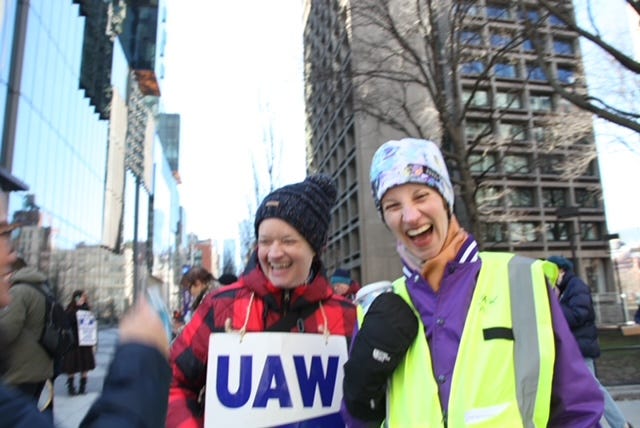
Anne and Carley on the picket line.
Carley and Susanna on the picket line.
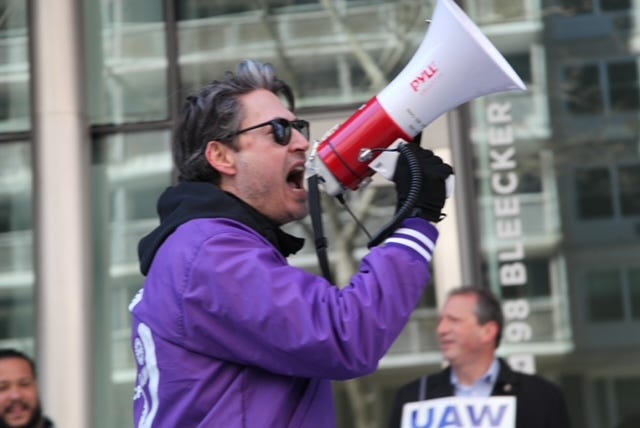
David and Brad Lander.
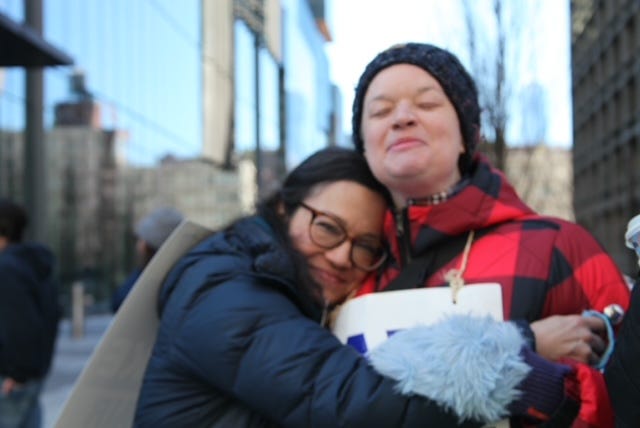
Noel and Carley on the picket line.
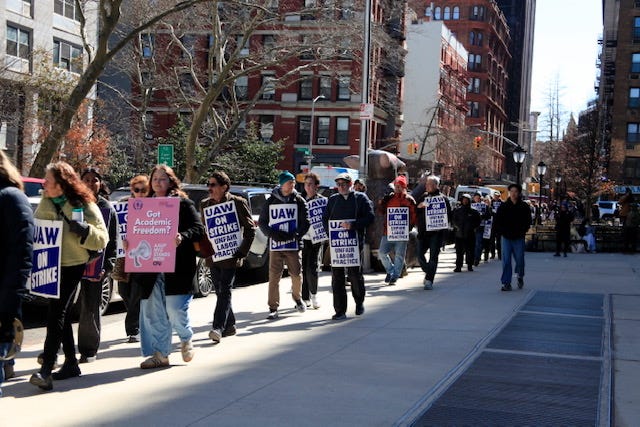
The picket line. Another new friend of mine in Tisch, cari ann said to me the other day, that the magic of the picket is partially because it’s a circle and circles are always a part of sacred rituals. I love that!
organizing is addictive...more strike please. lol
lerv!!
Great work. I realize as I am Swedish -I don’t know what ”picket” and picketing means ;)